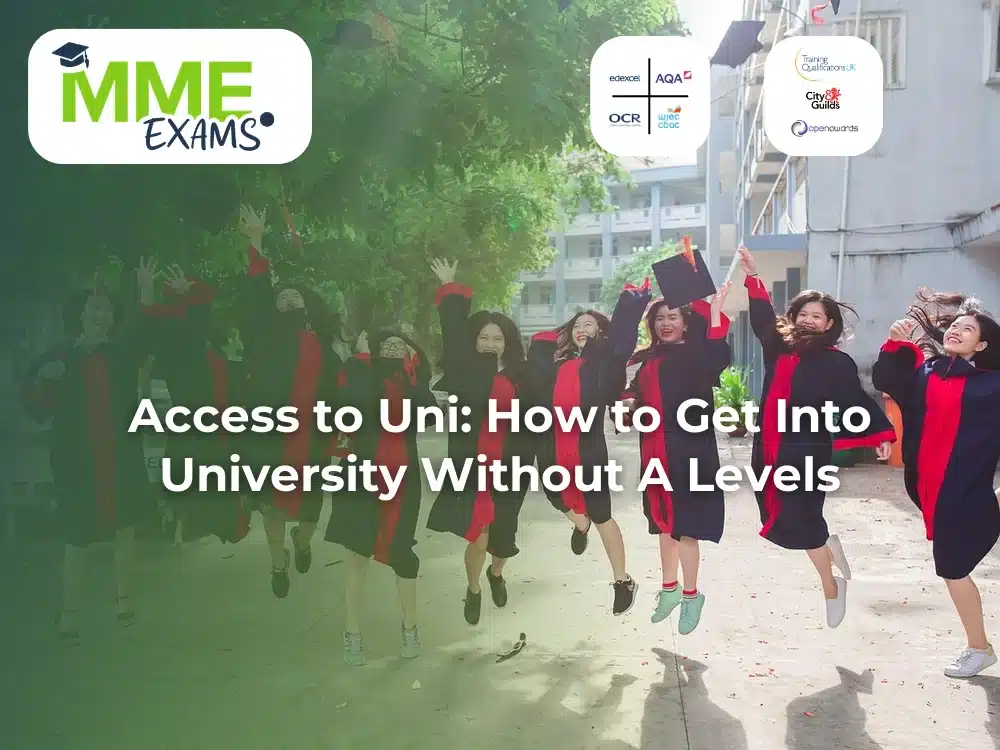
Access to Uni: How to Get Into University Without A Levels
If the thought of sitting in an exam hall again fills you with dread, you are not alone, and it does not have to stand between you and a degree. Plenty of adults who never took A Levels, or took them years ago, are finding their access to uni through a qualification that is assessed entirely through assignments rather than timed papers.
This guide looks at what that route involves, how it compares with going back to study A Levels, and what to check before you commit.
What Is the Access to HE Diploma?
The Access to Higher Education Diploma is a nationally recognised Level 3 qualification regulated by the QAA (the Quality Assurance Agency for Higher Education). It was designed for adults who did not follow the traditional A Level route, and it is equivalent to three A Levels, worth up to 144 UCAS points. It is awarded by Open Awards, a UK-based awarding organisation recognised by the QAA as an Access Validating Agency.
Exams Versus Assignments: The Big Difference
For many adults, the biggest difference is how you are assessed. The Access to HE Diploma is 100% assignment-based, with no exams at all. Instead of everything resting on a few hours in an exam room, your result is built up piece by piece through the work you hand in, which usually takes these forms:
- Written assignments, such as essays, reports and structured written tasks
- Research tasks
- Reflective work, including reflective writing and case studies
Tutors give detailed feedback on what you submit, and resubmission may be allowed within the limits approved by the Access Validating Agency. If you produce your best work when you have time to plan, draft and improve, that is a very different experience from a single exam sitting.
How Universities View the Two Routes
A common worry is that a qualification without exams might be seen as the lesser option. According to Pass Learn, universities use the Access to HE Diploma in the same way as A Level results. It is accepted by hundreds of UK universities, including many Russell Group universities, and by initial teacher training (ITT) providers.
If you want the full picture of how an Access Diploma gets you into uni, keep one point in mind. Finishing the diploma lets you apply, but it does not guarantee a place. Every university sets its own entry requirements, especially for courses such as nursing, midwifery and physiotherapy, so check that your chosen university accepts the diploma for your course.
How Your Grades and Points Are Decided
Without a final exam, you might wonder how your result is worked out. The diploma is made up of 60 credits:
- 15 ungraded credits from study skills units, which prepare you for university-level work
- 45 graded credits from academic subject units linked to your chosen pathway
Each graded unit is marked Pass, Merit or Distinction, and only the graded credits count towards UCAS. As a general guide, the diploma is worth between 48 and 144 points, from an all-Pass profile at the lower end to all Distinctions at the top. It is worth reading up on UCAS points for Access to Higher Education before you decide which grades to aim for.
Some universities ask for a grade profile, such as a set number of credits at Distinction and Merit, rather than a points total, so always check how your course lists its requirements.
Swapping Revision for Steady Coursework
At MME Exams, we know how much effort goes into revising for a big exam, and how frustrating it can be when nerves take over on the day. If that sounds familiar, we recommend thinking honestly about which style of study brings out your best work before you choose a route.
With an assignment-based diploma, the habits you would normally pour into revision still matter, but they are spread across the whole course. Each graded unit is a fresh chance to earn a Distinction, so steady effort counts for more than a final push. A diploma tutor supports you from day one, and unit tutors mark your work and give feedback you can use in the next assignment.
Studying Online Around Adult Life
For adults juggling jobs or family, flexibility can matter as much as the assessment style. An online Access to Higher Education course can be studied 100% online, with no classroom and no fixed class times. Materials are available 24/7 from the moment you enrol, and assignments are submitted through the Diploma Portal.
At a fast-track pace, the diploma can be completed in as little as 6 to 9 months, while the standard pace usually takes 9 to 12 months. Start dates roll throughout the year, and you can request an extension or a study freeze if life gets in the way.
Who Can Enrol and What Else You Need
You do not need any GCSEs or A Levels to enrol. You must be 16 or over with a UK address, although the diploma is recommended for those aged 19 and over. Before you reach degree level, plan for the following:
- Most degrees ask for GCSE maths and English at grade 4/C or above, or an accepted equivalent such as Functional Skills Level 2
- Your Access pathway should match the subject requirements of the degree you want
Pass Learn can arrange Functional Skills or GCSEs alongside the diploma, so take a look at the online courses from Pass Learn if you have a gap in maths or English.
Applying and Planning the Cost
When you are ready to apply, UCAS has helpful guidance on going to university later in life. Full-time courses are applied for online through UCAS, while flexible and part-time courses are applied for directly with the university or college. For most undergraduate courses starting in 2027, the UCAS deadline is 13 January 2027 at 18:00 UK time.
UCAS also suggests looking into finance and support as one of the steps towards your degree, so it is worth building that into your plans early. For the diploma itself, Pass Learn describes its pricing as “Low Cost, No Hidden Fees”, with materials, tutor support, assessment and certification all included in the diploma fee. If paying in one go is difficult, you can spread the cost through options such as Clearpay, Klarna, Payl8r, Partially and PayPal.
Conclusion
Choosing between A Levels and an Access to HE Diploma often comes down to how you work best. If exams have held you back before, an assignment-based diploma lets you build your grade steadily, with tutor feedback along the way. Check your course’s entry requirements, plan ahead for maths and English, and pick the pathway that fits the degree you want.
Frequently Asked Questions
Are there any exams in the Access to HE Diploma?
No. The diploma is 100% assignment-based, made up of written assignments, research tasks and reflective work that you submit online.
Is the diploma really equivalent to A Levels?
It is a QAA-regulated Level 3 qualification, equivalent to three A Levels and worth up to 144 UCAS points.
Does finishing the diploma guarantee me a university place?
No. It allows you to apply, but entry is at the discretion of each university, so check your course requirements before you enrol.
How long does the diploma take to complete?
On the fast-track pace, it can take as little as 6 to 9 months. At the standard pace, it usually takes 9 to 12 months.

MME Exams Team
We help thousands of students each year with revision, courses and online exams.